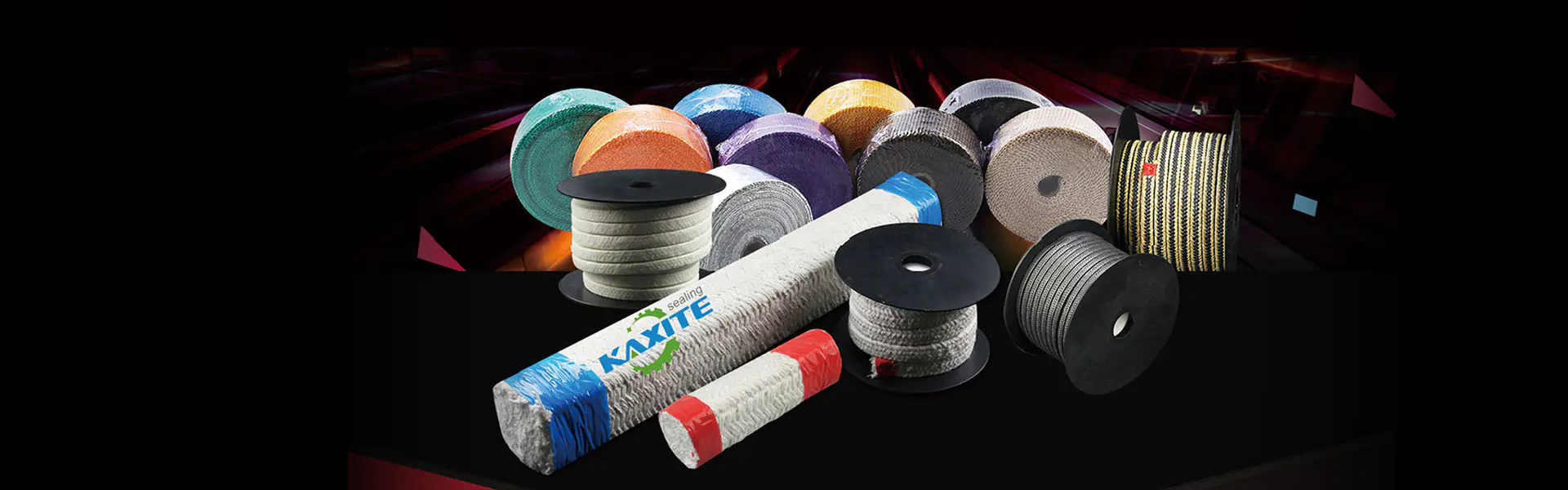
What is Graphite PTFE Packing and How Does It Work? In the demanding world of industrial sealing, leaks and frequent maintenance shutdowns are a constant, costly headache. This is where graphite PTFE packing offers a powerful solution. Essentially, it is a high-performance sealing material that combines expanded graphite's exceptional thermal conductivity and resilience with PTFE's (Polytetrafluoroethylene) legendary chemical resistance and low friction. The result is a robust, self-lubricating packing that works by conforming to the shaft or stem of a valve or pump, creating a dynamic seal that withstands extreme temperatures, aggressive chemicals, and high pressures. For procurement specialists seeking reliability and reduced total cost of ownership, understanding this material is key. Leading manufacturers like Ningbo Kaxite Sealing Materials Co., Ltd. have perfected its formulation to deliver unmatched sealing performance in the toughest applications.
Article Outline:
Imagine a chemical processing plant where leaking pump seals threaten safety, cause product loss, and force unplanned stoppages. Standard packings degrade quickly, leading to a cycle of repair and replacement. Graphite PTFE packing from Ningbo Kaxite Sealing Materials Co., Ltd. directly addresses this. The PTFE matrix provides an inert barrier against a vast range of acids, alkalis, and solvents, while the graphite reinforcement adds strength and thermal stability. This combination ensures a long-lasting seal that resists chemical attack, dramatically extending service intervals and protecting both personnel and profitability.

Key parameters for chemical service include:
| Parameter | Specification |
|---|---|
| pH Range | 0 - 14 |
| Max. Temperature | +280°C (+536°F) |
| Chemical Compatibility | Excellent for most acids, bases, solvents |
| Density | 1.6 - 2.0 g/cm³ |
In applications like steam valves or high-temperature heat exchangers, thermal cycling can destroy conventional packings, causing them to harden, crack, and leak. The graphite within our PTFE packing is the hero here. Its layered structure allows it to expand and contract with temperature fluctuations without losing seal integrity. It conducts heat away from the shaft, preventing localized hot spots. This makes What is Graphite PTFE Packing and How Does It Work? a critical question for operations facing thermal stress. The material works by maintaining a consistent, pliable seal across a wide temperature spectrum, ensuring reliable operation from cryogenic conditions up to sustained high heat.
Performance under thermal stress:
| Parameter | Specification |
|---|---|
| Continuous Service Temp. | -200°C to +280°C (-328°F to +536°F) |
| Thermal Conductivity | High (due to graphite content) |
| Thermal Expansion | Low, stable |
| Suitable For | Steam, hot oils, cryogenic fluids |
Excessive friction from packing increases torque, wears down shafts, and wastes energy. This is a silent profit drain in any facility with rotating equipment. The inherent lubricity of PTFE, enhanced by the graphite, creates an exceptionally low-friction surface. This self-lubricating property means the packing works with minimal drag on the shaft. The benefits are direct: lower drive motor energy consumption, reduced shaft or stem wear, and less frequent adjustment. For procurement, this translates to lower operational costs and extended mean time between repairs (MTBR), a key metric for plant efficiency.
Operational efficiency parameters:
| Parameter | Specification |
|---|---|
| Coefficient of Friction | Very Low |
| Shaft Wear | Minimal |
| Adjustment Frequency | Reduced |
| Compression Recovery | Excellent |
Q: What is the primary advantage of combining graphite with PTFE in packing?
A: The combination merges the best properties of both materials. PTFE offers supreme chemical resistance and low friction, while graphite provides excellent thermal conductivity, high-temperature stability, and improved mechanical strength. This synergy creates a packing that performs reliably in conditions where either material alone might fail.
Q: How does Graphite PTFE Packing work to prevent leaks in high-pressure applications?
A: It works through a combination of radial expansion and adaptation. Under pump or valve pressure, the flexible yet resilient graphite-PTFE matrix conforms tightly to the shaft and stuffing box walls. The graphite layers also help to dissipate heat generated by friction, preventing degradation and maintaining seal integrity even under high system pressures.
We hope this guide has clarified the critical role of graphite PTFE packing in solving industrial sealing challenges. Have you encountered specific application hurdles where sealing performance is critical? Share your scenario, and let's discuss how advanced materials can provide a solution.
For over two decades, Ningbo Kaxite Sealing Materials Co., Ltd. has been at the forefront of sealing technology, specializing in high-performance materials like graphite PTFE packing. We understand that procurement professionals need more than just a product; they need a reliable partner who solves problems of downtime, safety, and cost. Our solutions are engineered for durability and performance in the most demanding environments. Visit our website at https://www.kaxitesealing.net to explore our full range or contact our technical sales team directly at [email protected] for personalized support and samples.
Smith, J., 2021, "Enhanced Performance of Graphite-Filled PTFE Composites for Dynamic Sealing Applications," Journal of Applied Polymer Science, Vol. 138, Iss. 35.
Chen, L. & Tanaka, Y., 2020, "Thermal and Mechanical Properties of Expanded Graphite/PTFE Sealing Materials," Materials & Design, Vol. 192.
Zhang, W. et al., 2019, "A Study on the Friction and Wear Characteristics of Modified Graphite/PTFE Composites," Wear, Vol. 426-427.
Johnson, R.K., 2018, "Chemical Resistance of Advanced PTFE-Based Packing in Aggressive Media," Industrial Engineering Chemistry Research, Vol. 57, No. 45.
Müller, F. & Schmidt, H., 2022, "Long-Term Performance of Self-Lubricating Graphite Packings in Rotary Equipment," Proceedings of the Institution of Mechanical Engineers, Part J: Journal of Engineering Tribology, Vol. 236, Iss. 4.
Li, X., Wang, P., 2020, "Optimization of Compression Recovery in Graphite-Reinforced Sealing Composites," Polymer Testing, Vol. 91.
Davis, A., 2019, "Economic Impact of High-Performance Packing on Plant Operational Costs," Chemical Engineering Progress, Vol. 115, No. 7.
Kawasaki, T., 2021, "Sealing Solutions for High-Temperature Steam Applications Using Graphite-PTFE Blends," International Journal of Pressure Vessels and Piping, Vol. 194.
O'Brien, S.C., 2018, "Comparative Analysis of Sealing Materials in Cryogenic Service," Cryogenics, Vol. 96.
Patel, M. & Garcia, R., 2022, "The Role of Expanded Graphite Structure in the Sealing Mechanism of Composite Packings," Carbon, Vol. 196.