Kaxite · Gasket Category
When two dissimilar metal flanges are bolted together — carbon steel to stainless steel, or a flange under cathodic protection to a bare pipeline — the metal-to-metal contact creates a closed electrical circuit. Stray current flows through the joint, the anode corrodes, and the pipeline eventually leaks. Kaxite Flange Insulation Gasket Kits break that circuit completely, isolating the flange faces, the bolt shanks and the nuts with a complete engineered assembly.
Three standard grades cover most service conditions: G10 Garolite for general utility, PTFE / PEEK for high temperature and aggressive chemicals, and G11 Garolite / ceramic-filled polymer for marine and high-pressure seawater. Every kit is complete — center gasket, bolt sleeves, insulating washers, and steel load-spreading washers — so the joint is insulated on the first installation.
Send your flange size, pressure class, bolt size, media and temperature — our engineering team replies with a material recommendation and price within 2 business hours.
At a glance
Flange Insulation Gasket Kits
Complete kit: center gasket + sleeves + insulating washers + steel washers. Custom sizes to drawing.
Kaxite Sealing (Ningbo Kaxite Sealing Materials Co., Ltd.) is an ISO 9001 certified manufacturer of industrial sealing products with 25+ years of experience. Our flange insulation gasket kits are produced in the standard grades — G10 Garolite, G11 Garolite, virgin PTFE, PEEK and ceramic-filled polymer — and supplied as complete kits with sleeves and washers matched to the flange bolt pattern.
Kits are manufactured to ASTM, NACE and ISO standards, and can be supplied with material certificates, dielectric test reports and dimensional inspection records. Third-party inspection (SGS, BV, TÜV or client-nominated) is supported. OEM/ODM branding and custom kit configurations are available.
Every kit ships with the center insulating gasket, bolt sleeves, insulating washers and steel washers — the full assembly needed for a fully insulated joint.
Standard G10 for utility service, PTFE / PEEK for high-temp and aggressive chemicals, G11 / ceramic-filled for marine. No need to source from multiple vendors.
Center gaskets are cut to match the flange ID, OD and bolt hole pattern — ASME / ANSI, DIN, EN, JIS or custom. Sleeve and washer dimensions are matched to the bolt size and quantity.
Small quantities for project qualification accepted. Bulk pricing for repeat production orders. OEM/ODM branding available.
Standard kits normally ship in 7–15 working days. Custom configurations and non-standard materials quoted against confirmed capacity. Reply within 2 business hours.
Material certificates, dielectric test reports and batch traceability available on request. Full ISO 9001 quality process documented.
A flange insulation gasket kit is not a single gasket. It is a system of five components that each block a different path for electrical current. Omitting any one component leaves the joint electrically conductive.
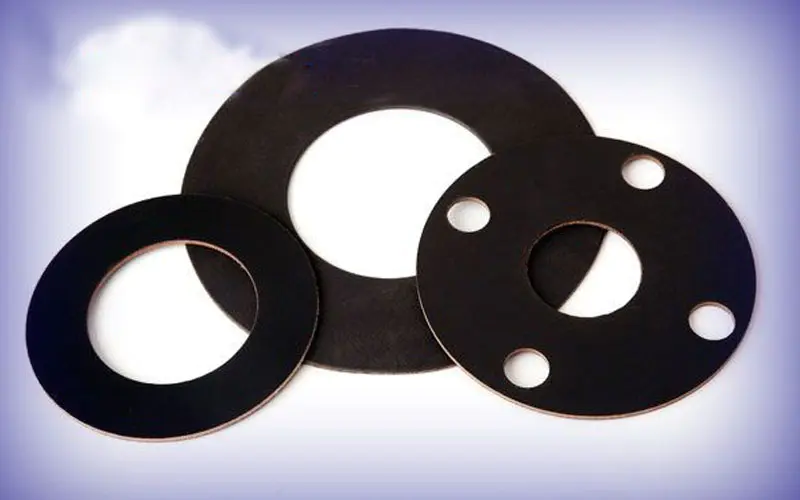
Precision-cut from G10, PTFE, PEEK or composite. Isolates the two flange faces. Precision-cut to match flange ID, OD and bolt hole pattern.
Polymer or ceramic sleeves that slide over each stud or through-bolt. Prevent the bolt shank from touching the flange bolt hole wall.
Placed against the flange faces on both the nut side and the bolt head side. Isolate the fastener from the flange faces.
Heavy-duty flat washers placed between the insulating washer and the nut. Distribute torque load and prevent over-compression of the insulating components.
Non-metallic pins that align the flange faces and bolt holes during assembly without damaging the insulating gasket. Available on request.
Using only the center insulating gasket, without the sleeves and insulating washers, is the most frequent mistake in flange insulation. The metal bolt shank creates a direct electrical bridge between the two flanges, bypassing the gasket and rendering the entire installation electrically conductive. The complete kit is mandatory for a fully insulated joint.
Kaxite flange insulation gasket kits are available in three standard grades. They differ in base material, temperature and pressure capability, dielectric strength and chemical resistance.
| Parameter | Standard Grade Kit | High-Temp / Chemical Grade Kit | Marine Grade Kit |
|---|---|---|---|
| Primary gasket material | G10 Garolite (epoxy glass laminate) | Virgin PTFE or PEEK | G11 Garolite or specialty composite |
| Temperature range | -51 °C to +121 °C | -268 °C to +260 °C (PTFE) | -51 °C to +149 °C |
| Pressure rating | Up to 103 bar (1500 psi) | Up to 69 bar (1000 psi) for PTFE; higher for PEEK | Up to 138 bar (2000 psi) |
| Dielectric strength | > 50 kV at 0.125" | > 40 kV at 0.062" (PTFE) | > 55 kV at 0.125" |
| Bolt sleeve / washer material | Polypropylene or Nylon | PTFE or PPS | PVDF (Kynar) or ceramic-filled polymer |
| Chemical resistance | Oils, alkalis, dilute acids | Nearly all industrial chemicals | Saltwater, acids, fuels |
| Common standards | ASTM D709, NACE MR0175 | ASTM D4894, FDA-compliant options | ASTM D710, MIL-I-24768 |
| Typical applications | Plant water lines, fuel oil piping, general chemical service | Aggressive acid / alkali lines, high-purity systems, pharmaceutical | Offshore platforms, shipboard piping, seawater cooling lines |
The table is a guide only. Final grade selection depends on the specific media, temperature, pressure and required dielectric strength. Tell us the service conditions and we will confirm the correct grade.
Kits are manufactured to match standard flange dimensions and bolt patterns. The table below shows the kit configuration for common ASME / ANSI flange sizes. DIN, EN and JIS flange configurations are available on request.
| Nominal pipe size (NPS) | Flange pressure class (ANSI) | Bolt hole diameter | Bolt size & quantity | Kit includes (per bolt) |
|---|---|---|---|---|
| 2" | 150 | 0.75" | 4 × 0.625" bolts | 1 sleeve, 2 insulating washers, 1 steel washer |
| 4" | 300 | 0.88" | 8 × 0.75" bolts | 1 sleeve, 2 insulating washers, 1 steel washer |
| 8" | 150 | 0.88" | 8 × 0.75" bolts | 1 sleeve, 2 insulating washers, 1 steel washer |
| 12" | 600 | 1.12" | 12 × 1.00" bolts | 1 sleeve, 2 insulating washers, 1 steel washer |
| 16" | 900 | 1.38" | 16 × 1.25" bolts | 1 sleeve, 2 insulating washers, 1 steel washer |
Standard kit includes one insulating sleeve and two insulating washers per bolt, plus a steel washer for load spreading. Send us your flange drawing or flange specification and we will confirm the kit configuration and price.
Clean both flange faces, remove any rust, scale or old gasket material. Verify the faces are smooth and undamaged.
Center the insulating gasket between the two flange faces. Use non-metallic alignment pins if supplied.
Slide an insulating sleeve over each bolt. Insert the bolt through the flange holes. On the nut side, place an insulating washer, then a steel washer, then the nut.
Tighten in a star / cross pattern to the specified torque in progressive steps. After installation, verify insulation resistance with a megohmmeter — reading should be in the megaohm range.
Flange insulation gasket kits are part of Kaxite's full gasket and sealing range. Related products in the same family include:
The primary purpose is to prevent galvanic corrosion in pipeline systems. It creates a dielectric barrier that stops the flow of electrical current between two dissimilar metal flanges or between a flange and its connecting bolts. By interrupting this circuit, it prevents the electrochemical reaction that causes metal ions to dissolve, thereby eliminating a major cause of pipeline failure and leaks.
Use is often mandated by engineering standards, safety codes and client specifications in situations involving: cathodic protection systems (to isolate protected sections), pipelines with dissimilar metals (e.g., carbon steel to stainless steel), pipelines entering or leaving electrolyte-rich environments (soil, seawater), and hazardous areas where stray currents could cause sparks. They are also critical for electrical grounding isolation in industrial facilities.
No — this is a common and serious error. Using only the center gasket fails to provide complete isolation. The metal bolts create a direct electrical bridge between the two flanges, rendering the gasket ineffective. The full kit — with sleeves to isolate the bolt shank and washers to isolate the nut and head — is essential for a fully insulated joint.
Material selection is based on three key service conditions: temperature, pressure and chemical media. For general utility services up to 121 °C, G10 Garolite is robust and cost-effective. For extreme temperatures or highly corrosive chemicals, PTFE or PEEK is necessary. For high-pressure seawater applications, a high-strength composite like G11 or a ceramic-filled polymer is recommended. Always consult chemical compatibility charts.
First, ensure flange faces are clean, smooth and undamaged. Dry fit all components. Insert non-metallic alignment pins if provided. Place the center insulating gasket. For each bolt, slide an insulating sleeve over it, then insert the bolt through the flange holes. On the nut side, place an insulating washer against the flange, followed by a steel washer, then the nut. On the head side, place a steel washer, then an insulating washer against the flange before tightening. Tighten bolts in a star / cross pattern to the specified torque in progressive steps.
The target torque is typically the standard torque specified for the flange rating, bolt size and gasket material. However, caution must be taken not to over-torque, which can crush or fracture the insulating components. It is vital to follow the kit manufacturer's torque recommendations, which may differ slightly due to the lubrication effect of polymer washers. Using a calibrated torque wrench and the cross-tightening sequence is non-negotiable.
A properly selected and installed kit does not negatively affect the pressure rating. The insulating gasket must be of appropriate thickness and material to handle the design pressure and temperature. The kit components are engineered to work within the flange's mechanical design. The key is ensuring the gasket material's pressure-temperature rating is suitable for the service and that correct installation creates a uniform seal.
Yes, but selection and installation require extra care. Materials like PTFE can cold-flow under constant load, potentially leading to loosening. In such services, it is advisable to use more rigid gasket materials like G10 / G11 or PEEK and to implement a re-torquing schedule after initial heat cycles or periods of operation to maintain bolt load and seal integrity.
Insulation resistance should be tested after installation. Using a low-resistance ohmmeter or a megohmmeter, measure the electrical resistance across the isolated flange joint. The reading should be very high, typically in the megaohm range, confirming no conductive path exists. Regular testing as part of a maintenance programme is recommended to detect any insulation breakdown over time.
Generally, no. The insulating gasket, sleeves and washers are subject to compression set and potential damage during disassembly. Reusing them risks a loss of sealing capability and dielectric integrity. Best practice is to replace all insulating components with a new kit whenever the flange joint is broken and re-made. The steel washers may be reusable if undamaged.
Send us your flange size, pressure class, bolt size and quantity, operating temperature, and process media — or a copy of your piping specification or flange drawing — and we will come back with a grade recommendation, kit configuration, price and realistic delivery date. OEM/ODM and custom kit configurations available.