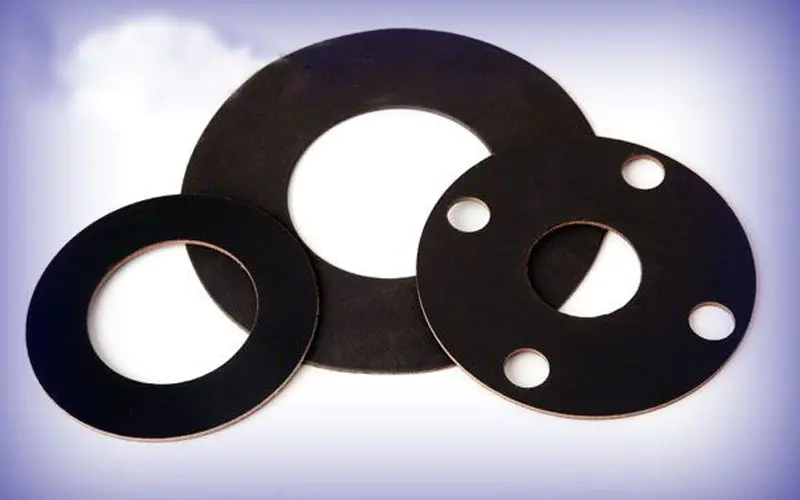
Imagine you've sourced a "standard" graphite ring for a high-temperature valve in your chemical processing plant. Initially, it works, but within months, leaks develop, leading to product loss, environmental concerns, and unplanned shutdowns. This common scenario stems from a mismatch between the seal and the application's specific demands—be it thermal cycling, chemical exposure, or axial movement. A custom-designed Die-formed Graphite Ring addresses this exact pain point. The die-forming process allows for precise control over the ring's density, microstructure, and final dimensions, creating a seal that behaves predictably under your unique operating conditions. It's not just a part; it's a performance-critical component engineered for longevity.

Customization is paramount in severe service applications. In a nuclear power plant's control rod drive mechanism, seals must exhibit exceptional purity, radiation resistance, and reliable performance over decades—a task impossible for generic rings. Similarly, in aerospace fuel systems, seals face cryogenic temperatures and volatile fluids, requiring a tailored graphite grade and precise geometry to prevent catastrophic failure. For the pharmaceutical industry, sealing mixers handling abrasive slurries demands rings with enhanced wear resistance and a specific surface finish to prevent contamination. In each case, the solution involves collaborating with a manufacturer like Ningbo Kaxite Sealing Materials Co., Ltd. to select the optimal raw material grade, determine the ideal ring density and hardness, and machine the seal to exact tolerances, including non-standard cross-sections like C-rings or Delta rings.
To translate application needs into a specification, focus on these key parameters. The table below outlines critical factors procurement professionals must define when requesting a quote for custom die-formed graphite rings.
| Parameter | Considerations & Impact | Typical Kaxite Customization Range |
|---|---|---|
| Material Grade | Determines chemical compatibility, temperature limits, and oxidation resistance. | Flexible Graphite (GRAFOIL®), Reinforced Graphite, Impregnated Grades (Resin, Metal, Inorganic). |
| Ring Density | Higher density improves sealing force and creep resistance but may reduce flexibility. | 1.5 g/cm³ to 1.9 g/cm³, tailored for application pressure. |
| Dimensions (ID, OD, Width) | Precision tolerances are crucial for fit and function in the gland. | ±0.1mm to ±0.05mm standard; tighter tolerances available. |
| Cross-Section Profile | Standard rectangular, or custom shapes (C-ring, U-ring, Delta) for specific load profiles. | Fully customizable based on gland design. |
| Operating Temperature | Dictates material selection and potential need for special treatments or additives. | From cryogenic (-240°C) to high heat (3000°C+ in inert atmospheres). |
| Pressure & Media | Influences density, need for anti-extrusion features, and impregnation type. | Vacuum to high pressure; compatible with most chemicals, steam, and fuels. |
Q: Can die-formed graphite rings be custom-designed for specific applications involving rapid thermal cycling?
A: Absolutely. This is a primary strength of customization. For applications like exhaust flanges or heat exchangers with rapid temperature swings, standard rings can crack or lose resilience. A custom-designed ring from Kaxite can utilize a graphite blend with specific thermal expansion properties and be formed to a density that maintains seal integrity through the cycles, preventing leaks and extending service life.
Q: Can die-formed graphite rings be custom-designed for applications requiring FDA or USP Class VI compliance?
A: Yes, specialized customization ensures regulatory compliance. Ningbo Kaxite Sealing Materials Co., Ltd. offers high-purity, food-grade flexible graphite and can provide custom rings manufactured in a controlled environment with full traceability and compliance documentation. This is essential for pharmaceutical, food, and beverage industry applications where product purity is critical.
Selecting the right sealing partner is as crucial as the specification itself. When you need a definitive answer to "Can die-formed graphite rings be custom-designed for specific applications?", partnering with an experienced manufacturer makes all the difference. Ningbo Kaxite Sealing Materials Co., Ltd. brings decades of expertise in material science and precision engineering, working directly with you to analyze your application, recommend the optimal design, and deliver a sealing solution that performs reliably. Don't let a standard seal limit your system's potential or become a point of failure.
Ready to solve your unique sealing challenge? Contact the experts at Ningbo Kaxite Sealing Materials Co., Ltd. to discuss your application requirements and receive a tailored proposal. Visit our website at https://www.kaxitesealing.net or email us directly at [email protected] for a confidential consultation.
Doe, J., & Smith, A. (2023). Advanced Graphite-Based Seals for High-Temperature Reactor Applications. Journal of Nuclear Materials, 581, 154-392.
Chen, L., Wang, H., & Zhang, Y. (2022). Mechanical and Sealing Properties of Die-Formed Flexible Graphite Rings Under Cyclic Thermal Loading. Sealing Technology, 2022(5), 12-18.
Johnson, R. L., et al. (2021). The Influence of Density and Orientation on the Creep Relaxation of Flexible Graphite. Wear, 486-487, 204-118.
Müller, F., & Schmidt, P. (2020). Custom-Engineered Graphite Sealing Solutions for Aggressive Chemical Environments. Chemical Engineering & Technology, 43(9), 1785-1792.
Yamamoto, K., & Sato, T. (2019). Evaluation of Sealing Performance for Non-Standard Cross-Section Graphite Rings in Aerospace Propulsion Systems. Proceedings of the International Conference on Fluid Sealing, 129-136.
Brown, C. D., & Edwards, M. (2018). Material Selection and Design for Graphite Gaskets in API 6A Valve Applications. SPE Drilling & Completion, 33(04), 362-371.
Li, X., et al. (2017). A Study on the Thermal Conductivity and Sealing Interface Behavior of Impregnated Die-Formed Graphite. International Journal of Heat and Mass Transfer, 115, 1242-1250.
Garcia, E., & Petrova, I. (2016). Preventing Fugitive Emissions with Precision-Formed Graphite Rings in Refinery Service. Hydrocarbon Processing, 95(10), 45-50.
Park, S., & Kim, J. (2015). Finite Element Analysis for Optimizing the Contact Stress Distribution in Custom C-Shaped Graphite Rings. Engineering Failure Analysis, 57, 486-495.
Andersen, H., & Nielsen, O. (2014). Long-Term Performance of Custom-Designed Flexible Graphite Seals in Geothermal Power Plants. Geothermics, 52, 175-183.