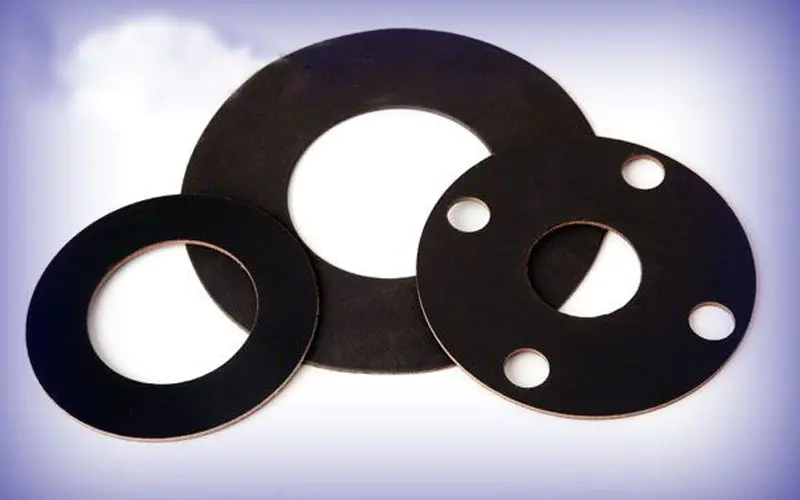
Should I use copper gasket sealant with a copper exhaust gasket? Picture a procurement manager at a busy repair shop staring at a returned exhaust job: the Copper Exhaust Gasket looked right, the bolts were tight, but the customer heard a tick-tick-tick leak after two heat cycles. The technician asks for sealant, the counter staff suggests anti-seize, and the buyer needs a repeatable answer that will not create comebacks. The honest answer is that a copper exhaust gasket often works best when installed clean and dry, but not every copper gasket is the same. An embossed or coated gasket may have a designed sealing bead; a solid annealed copper gasket may need a different approach; a pitted flange may need a thin, high-temperature sealant assist. At Ningbo Kaxite Sealing Materials Co., Ltd., we see this decision most clearly when buyers compare gasket construction, flange finish, torque procedure, and oxygen sensor risk before choosing a sealant. Used correctly, copper gasket sealant can fill small imperfections and support a repair. Used blindly, it can migrate, change clamp load, bake hard, contaminate sensors, and hide a flange problem that should be fixed. This guide turns that shop-floor pain into a practical buying and installation checklist for procurement teams, so you can decide when dry installation is safer and when a sealant-assisted install is justified.
Article outline
The pain point is rarely the gasket alone. A buyer receives a complaint that a copper exhaust gasket leaked after installation, yet the same part number worked on a different engine. In many cases, the first repair used a sealant because the flange looked imperfect, and the second repair used no sealant because the technician trusted the new gasket. Both teams thought they followed the right process. The missing step is a decision rule: dry installation is preferred when the gasket has a designed sealing bead, the flange is flat and clean, and the OEM procedure specifies dry torque. A sealant-assisted installation is considered only when the gasket construction allows it, the flange has minor pitting or roughness within an approved limit, and the sealant is rated for exhaust temperature and sensor exposure.
For procurement teams, this rule protects cost, warranty, and repeatability. Ask the gasket supplier for the installation intent in writing. If the copper exhaust gasket is embossed, coated, or multi-layer, dry installation usually protects the bead and keeps torque predictable. If it is a solid copper gasket with a soft anneal, a thin high-temperature sealant may help in a repair scenario, but the flange condition and torque should still be checked. Ningbo Kaxite Sealing Materials Co., Ltd. supports buyers by matching gasket construction to the application, not by selling one universal sealant answer.
| Decision factor | Dry installation is usually best when | Sealant may help when | Procurement check |
|---|---|---|---|
| Gasket construction | Embossed, coated, multi-layer, or OEM dry design | Solid copper gasket and approved repair procedure | Request written installation guidance |
| Flange finish | Flat, clean, and within specification | Minor pitting or scratches within an approved limit | Measure flatness and surface condition |
| OEM procedure | Dry torque and sequence are specified | Sealant is permitted with cure and torque notes | Keep the OE document in the job file |
| Temperature and sensor risk | High exhaust temperature and nearby oxygen sensor | Sealant is sensor-safe and temperature-rated | Request TDS and SDS before approval |
| Reusability | Single-use gasket | Reusable solid copper gasket with approved reconditioning | Confirm reuse policy in writing |
The pain point begins with a label. A buyer sees “copper” on a sealant can and “copper” on an exhaust gasket and assumes the two products are matched. In reality, copper anti-seize, anaerobic flange sealant, high-temperature RTV, and graphite paste each do different jobs. Copper anti-seize is mainly for fastener threads and galling protection; it is not a guaranteed gasket sealant. Anaerobic sealant cures when air is excluded and can work on rigid flange joints, but it may not fill a hot exhaust gap or tolerate the same movement. High-temperature RTV can fill small gaps, yet some silicone formulations can harm oxygen sensors if excess material enters the exhaust stream. The solution is to match the product chemistry to the gasket design, operating temperature, and sensor position.
When a customer asks, “Should I use copper gasket sealant with a copper exhaust gasket?”, the safest procurement response is to request the gasket supplier’s position and the sealant maker’s technical data sheet. Look for continuous temperature rating, cure requirements, gap fill, friction effect, and sensor-safe language. A copper exhaust gasket from Ningbo Kaxite Sealing Materials Co., Ltd. can be supplied with application guidance so the buyer knows whether the part is intended for dry installation or whether a sealant assist is acceptable in a repair. That clarity reduces trial-and-error purchasing and helps the service team follow one approved process.
| Sealant type | What it does well | Risk with a copper exhaust gasket | Specification to request |
|---|---|---|---|
| Copper anti-seize | Protects threads and reduces galling | Can migrate, change friction, and create a false seal | Particle size, carrier, temperature rating |
| Anaerobic flange sealant | Cures in tight metal-to-metal joints | May not fill exhaust gaps or tolerate thermal movement | Gap fill, temperature, OEM approval |
| High-temperature RTV | Fills minor imperfections and adds flexibility | Excess material may contaminate an oxygen sensor | Sensor-safe claim, cure time, temperature |
| Graphite or ceramic paste | High-temperature release and anti-seize | Can lubricate the joint and alter torque preload | Friction coefficient, solids content, rating |
| No sealant | Preserves the gasket’s designed sealing bead | Leaks if the flange is damaged or poorly prepared | Flatness, finish, torque, and sequence |

The pain point often appears after a successful first install and a failed second install. The part number did not change, but the flange did. A warped manifold, a rough surface, a dirty bolt hole, or an impact gun instead of a calibrated torque wrench can turn the same copper exhaust gasket into a leak. Sealant cannot correct a flange that is out of flatness, and too much sealant can create a hydraulic effect or prevent the gasket from seating. The solution is to control the variables before deciding on sealant: clean both surfaces, check flatness, confirm the gasket orientation, use the correct fastener condition, and follow the torque sequence in stages.
Thermal cycling is the next variable. Exhaust parts expand and contract, and a sealant that stays flexible at one temperature may bake hard at another. If the OEM allows re-torque, check the value and timing after the first heat cycle. If the OEM does not allow re-torque, do not invent a procedure. For buyers, this means the sealant decision belongs in the installation work instruction, not only in the purchasing file. Ningbo Kaxite Sealing Materials Co., Ltd. can help review the gasket thickness, material temper, and flange conditions so the buying team can issue a clear dry-install or sealant-assisted instruction to the workshop.
| Installation variable | Target or check | Why it changes the sealant decision | Action |
|---|---|---|---|
| Flange flatness | Within the OEM limit; check with a straight edge | Low spots need gap fill or resurfacing | Resurface first; use sealant only if approved |
| Surface roughness | Clean, dry, lint-free, and within specification | A rough surface can tear the gasket or need extra fill | Measure and document if specified |
| Torque sequence | OEM value and staged pattern | Sealant can reduce friction and change clamp load | Use a calibrated wrench; no guesswork |
| Thermal cycling | Continuous and peak exhaust temperature | Sealant may pump, bake, or lose elasticity | Re-torque only if the OEM allows |
| Fastener condition | Clean threads and correct grade | Lubricant or sealant changes preload | Document friction and procedure |
The pain point for a purchasing team is variation. One shipment of copper exhaust gaskets seals well, while another creates comebacks because the thickness, temper, coating, or hole tolerance changed. When the workshop then adds sealant to compensate, the process becomes harder to control. The solution is to buy to a written specification and keep the sealant policy separate from the gasket specification. Define material grade, thickness, temper, coating or impregnation, dimensions, temperature rating, traceability, and the approved installation method. If a sealant is allowed, name the approved product family and require the supplier to state the torque effect.
This is where a sealing materials partner can remove guesswork. Ningbo Kaxite Sealing Materials Co., Ltd. works with automotive and industrial buyers on copper exhaust gasket specifications, samples, and repeat-order consistency. The team can review a drawing, recommend a material and thickness, and provide an installation note that tells the service team whether to install dry or use an approved sealant assist. That support helps procurement protect warranty cost while giving engineering a clear technical basis for the decision. It also answers the practical question behind “Should I use copper gasket sealant with a copper exhaust gasket?” with a documented process instead of a counter-counter opinion.
| Specification | Example buyer requirement | Why it matters | Supplier support to request |
|---|---|---|---|
| Material grade | Copper grade and temper per drawing | Controls conformability, heat transfer, and creep | Material certificate and traceability |
| Thickness | 0.5 mm, 1.0 mm, or 1.5 mm as specified | Affects clamp load and gap fill | Custom thickness review |
| Coating or impregnation | None, graphite, or anti-stick as approved | Changes release and sealing behavior | Compatibility advice |
| Dimensions | ID, OD, bolt holes, and port shape | Fit and leak path depend on accurate geometry | Tooling review and samples |
| Temperature rating | Continuous and peak exhaust temperature | Prevents early failure under heat cycles | Application review |
| Sealant policy | Dry install or approved sealant only | Reduces comeback and sensor damage risk | Written installation note |
Use copper gasket sealant only when the gasket construction, flange condition, and OEM procedure support it. Many copper exhaust gaskets are designed to seal dry, especially embossed or coated types. A thin, high-temperature, sensor-safe sealant may help a solid copper gasket on a slightly imperfect flange, but it should not be used to hide a warped or damaged flange. Confirm the sealant temperature rating, cure method, and torque effect before approval.
No. Copper anti-seize is mainly a thread lubricant and galling preventative. It can change fastener friction and may migrate into the exhaust path. It is not a substitute for a gasket sealant unless the sealant maker and gasket supplier both approve that use. For a copper exhaust gasket, keep anti-seize on the fastener threads only if the OEM permits it, and keep the gasket sealing surface clean.
Some silicone-based sealants can contaminate oxygen sensors if excess material enters the exhaust stream. Choose a sensor-safe product and apply a thin film only where the installation instruction allows it. Avoid heavy beads that can squeeze into the bore. If the engine uses a close-coupled sensor, the risk deserves a formal review before any sealant is approved.
First measure the damage. Light pitting may be acceptable with a conformable copper gasket and correct torque. Deeper pitting should be resurfaced or repaired. A sealant can fill minor imperfections only if it is rated for the temperature and is approved for the application. Do not use sealant as a permanent fix for a flange that is out of flatness.
Follow the OEM procedure. Some exhaust joints require a re-torque after the first heat cycle; others do not. If re-torque is allowed, use the specified value and sequence with a calibrated wrench. If a sealant was used, check whether the sealant maker recommends a cure time before heat exposure. Mixing an unapproved re-torque routine with sealant can reduce clamp load and create a new leak path.
Base the choice on flange condition, OEM thickness, surface finish, and operating temperature. A thicker gasket can conform to minor imperfections but may change clamp load and joint stiffness. A thinner gasket can suit a flat, well-machined flange. Ningbo Kaxite Sealing Materials Co., Ltd. can review the drawing and application data to recommend a thickness and material temper that match the exhaust joint.
The pain point at the buying stage is uncertainty: the workshop wants a sealant, the engineer wants a dry install, and the buyer needs a decision that will hold across repeat orders. The solution is to collect the right data before the purchase order is released. Ask for a flange photo, a drawing with dimensions, the engine or equipment model, continuous and peak temperature, current gasket construction, and the technical data sheet of any sealant under consideration. With those details, the gasket supplier can state whether dry installation is preferred or whether a sealant-assisted repair is acceptable.
| Buyer action | What to send | What to request back |
|---|---|---|
| Confirm fit | Flange drawing, port shape, bolt pattern | Gasket dimensions and sample recommendation |
| Confirm material | Operating temperature and engine model | Copper grade, temper, and thickness advice |
| Confirm installation | Current sealant TDS and flange photos | Dry-install or sealant-assisted written note |
Have a flange drawing, a leaking part number, or a sealant question? Send the details to Ningbo Kaxite Sealing Materials Co., Ltd. through https://www.kaxitesealing.net or email [email protected]. Ningbo Kaxite Sealing Materials Co., Ltd. is a sealing materials supplier focused on copper exhaust gaskets, high-temperature gaskets, and application-specific sealing solutions for automotive and industrial buyers. The team helps procurement and engineering teams compare material grades, thickness, coating, tolerance, and installation requirements, then supports samples, drawings, and repeat-order consistency. If you are still asking, “Should I use copper gasket sealant with a copper exhaust gasket?”, Kaxite can review your flange condition, gasket construction, and operating temperature to recommend a dry-install or sealant-assisted approach that fits your process rather than a one-size-fits-all answer.
Research References
Abid, M., and Nash, D. H., 2006, Performance testing of a gasketed bolted flange joint under combined internal pressure and thermal transient, Journal of Pressure Vessel Technology, 128(3).
Sawa, T., and Takagi, Y., 2005, Sealing performance of bolted flange joints with gaskets under thermal and mechanical loading, Journal of Pressure Vessel Technology, 127(4).
Nassar, S. A., and Alkelani, A. A., 2006, Clamp load loss due to elastic interaction and gasket creep in bolted joints, Journal of Pressure Vessel Technology, 128(3).
Fukuoka, T., and Takaki, T., 2003, Finite element analysis of bolted flange joints with gaskets under thermal loading, Journal of Pressure Vessel Technology, 125(2).
Wang, Y., and Li, X., 2017, Leakage mechanisms of bolted flange joints with metal gaskets under thermal gradients, Journal of Pressure Vessel Technology, 139(5).
Ebara, R., and Toshimitsu, Y., 2011, Effect of surface roughness on sealing performance of metal gaskets, Tribology International, 44(12).
Park, S., and Cho, H., 2020, Evaluation of anaerobic sealants for rigid flange joints under vibration, International Journal of Adhesion and Adhesives, 98.
Kim, J. H., and Lee, S. H., 2019, Thermal cycling effects on exhaust manifold gasket sealing performance, Applied Thermal Engineering, 156.
Murali, K., and Sridhar, S., 2018, High-temperature sealing behavior of copper-based gaskets for automotive exhaust systems, Sealing Technology, 2018(7).
Zhang, L., and Chen, Y., 2021, Review of high-temperature sealing materials for automotive exhaust applications, Materials & Design, 205.
-