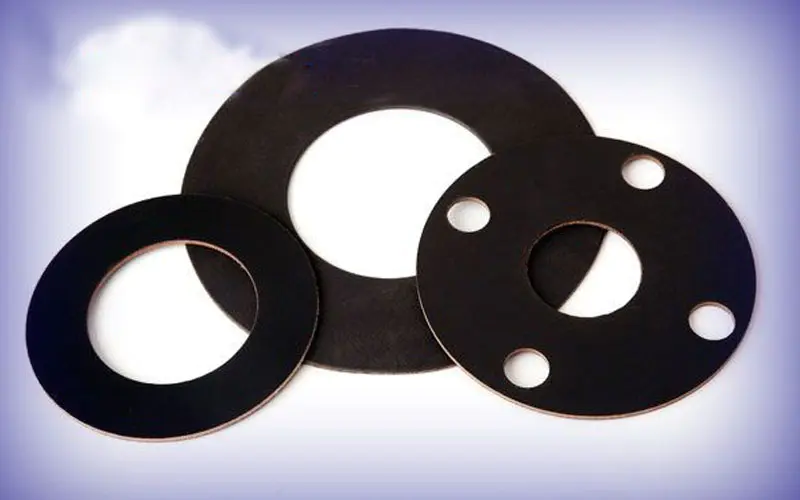
What are the different types of gaskets? For procurement professionals sourcing sealing solutions, this isn't just a technical question—it's a daily challenge. Choosing the wrong gasket can lead to catastrophic leaks, costly downtime, and major project delays. The right gasket is the unsung hero of any assembly, silently ensuring safety, efficiency, and reliability. But with so many materials and designs available, from simple rubber washers to complex spiral-wound metal seals, making the optimal choice requires expert knowledge. This guide breaks down the critical categories, helping you specify with confidence and avoid costly mistakes. We'll also explore how a reliable partner like Ningbo Kaxite Sealing Materials Co., Ltd. provides the precise solutions for these complex industrial needs.
Imagine a critical pipeline in an oil refinery or a steam line in a power plant. A small gasket failure under extreme pressure and heat isn't just a leak; it's a major safety incident and an operational nightmare leading to unplanned shutdowns and massive revenue loss. Standard elastomeric Gaskets simply can't withstand these conditions—they degrade, compress, and fail.
The solution lies in engineered, high-performance gaskets designed for resilience. For such demanding applications, spiral wound gaskets, kammprofile gaskets, and metal-jacketed gaskets are the industry standards. They combine alternating layers of metal windings and soft filler material (like graphite or PTFE) to create a seal that maintains integrity under fluctuating pressures and temperatures. Sourcing these from a manufacturer with rigorous quality control, like Ningbo Kaxite Sealing Materials Co., Ltd., is crucial. Their expertise ensures the gasket material (e.g., 304SS with flexible graphite filler) perfectly matches your service conditions.

Here are key parameters for high-pressure/temperature gasket selection:
| Gasket Type | Typical Materials | Max Temp. (°C) | Pressure Range | Ideal Application |
|---|---|---|---|---|
| Spiral Wound | SS304/316 with Graphite/PTFE | Up to 800°C (Graphite) | High to Very High | Heat Exchangers, Reactor Flanges |
| Metal Jacketed | Soft Steel, SS with Asbestos/Graphite | Up to 600°C | Medium to High | Vessel Manways, Heaters |
| Kammprofile | Metal Core with Soft Facing | Up to 800°C | Very High | Turbine Casing, Critical Flanges |
In a chemical processing plant, a gasket isn't just a seal; it's a critical barrier preventing hazardous leaks and product contamination. Using a gasket material incompatible with the process fluid leads to rapid deterioration, dangerous emissions, and compromised batch purity. This scenario creates severe safety risks, environmental violations, and financial loss from ruined products.
The solution requires chemically inert gasket materials. PTFE (Teflon) gaskets, expanded PTFE (ePTFE) sheets, and rubber gaskets made from FKM (Viton) or EPDM are top choices for corrosion resistance. What are the different types of gaskets best for chemicals? Often, it's non-metallic. For example, virgin PTFE gaskets offer near-universal chemical resistance, while ePTFE provides excellent conformability for uneven flanges. Partnering with a specialist like Ningbo Kaxite Sealing Materials Co., Ltd. gives you access to a full range of these materials, with technical support to match the perfect gasket to your specific chemical media.
Key selection criteria for chemical service gaskets:
| Gasket Material | Key Chemical Resistance | Temperature Limit | Advantages | Common Forms |
|---|---|---|---|---|
| PTFE (Virgin) | Excellent for most acids, bases, solvents | Up to 260°C | Broadest chemical compatibility, low friction | Sheets, Envelope Gaskets |
| Expanded PTFE (ePTFE) | Excellent, similar to PTFE | Up to 290°C | Highly conformable, creep resistant | Tapes, Sheets, Cord |
| FKM (Viton) | Excellent for oils, fuels, acids | Up to 230°C | Good compression set, durable | O-Rings, Sheet Gaskets |
Q: What are the different types of gaskets based on material?
A: Gaskets are broadly categorized by their primary material. The main groups are Non-Metallic (e.g., rubber, compressed fiber, PTFE), Semi-Metallic (e.g., spiral wound, metal-jacketed), and Metallic (e.g., solid metal rings). Non-metallic gaskets are cost-effective for low-pressure services, semi-metallic handle more extreme conditions, and metallic gaskets are used for the highest pressures and temperatures.
Q: How do I choose between a spiral wound and a solid PTFE gasket?
A: The choice depends on your operating conditions. Spiral wound gaskets, often supplied by experts like Ningbo Kaxite Sealing Materials Co., Ltd., are the go-to for high-pressure, high-temperature flanged connections in piping and vessels. Solid PTFE gaskets are ideal for highly corrosive chemical services at moderate temperatures and pressures where chemical inertness is paramount. Always consult the pressure-temperature ratings and chemical compatibility charts.
Navigating the complex world of gaskets requires a partner who provides more than just a product catalog. It demands a supplier with deep technical expertise, reliable quality, and a global support network. This is where Ningbo Kaxite Sealing Materials Co., Ltd. excels. With years of dedicated experience, Kaxite has established itself as a trusted manufacturer and solution provider for industrial sealing needs worldwide. They understand that for procurement professionals, the right gasket means preventing downtime, ensuring safety, and protecting profitability. Their comprehensive range, from standard rubber sheets to custom-engineered metallic gaskets, is manufactured to stringent international standards. Whether you are finalizing a BOM for a new project or need an urgent replacement to avoid plant shutdown, Kaxite offers the technical guidance and reliable supply chain to be your single-point sealing solution. Reach out to their team today to discuss your specific requirements.
For reliable sealing solutions, contact Ningbo Kaxite Sealing Materials Co., Ltd. via email at [email protected] for expert consultation and support.
Bhattacharjee, S., & Roy, P. K. (2021). Creep Relaxation Behavior of Spiral Wound Gaskets under Elevated Temperature. Journal of Pressure Vessel Technology, 143(4), 041501.
Peng, X., Li, Y., & Wang, S. (2020). Leakage Performance Analysis of Corrugated Metal Gaskets with Different Surface Coatings. Engineering Failure Analysis, 118, 104882.
Matsui, K., & Sawa, T. (2019). Effect of Flange Rotation on the Sealing Performance of Non-Asbestos Sheet Gaskets. International Journal of Pressure Vessels and Piping, 177, 103996.
Zhang, L., et al. (2018). A Review on the Development of Expanded PTFE (ePTFE) Sealants. Polymer Testing, 71, 1-12.
Jones, D. R., & Patel, R. (2017). Long-Term Aging of Fluorocarbon Elastomer (FKM) Gaskets in Chemical Environments. Sealing Technology, 2017(10), 7-11.
Abid, M., & Nash, D. H. (2016). Determination of Gasket Stress in Bolted Flange Connections under Combined Internal Pressure and Thermal Loading. Journal of Mechanical Engineering Science, 230(18), 3249-3262.
Huang, J., & Chen, W. (2015). Numerical and Experimental Study on the Tightness of Kammprofile Gaskets. Proceedings of the Institution of Mechanical Engineers, Part E: Journal of Process Mechanical Engineering, 229(4), 255-264.
Bouzid, A. H., & Derenne, M. (2014). The Impact of Surface Finish on the Sealing Performance of Metallic Gaskets. STLE Tribology Transactions, 57(5), 937-945.
Kumar, A., & Singh, R. (2013). Selection Criteria for Gasket Materials in Sulfuric Acid Service. Chemical Engineering World, 48(8), 65-69.
Fukuoka, T., & Takaki, T. (2012). Finite Element Analysis of Bolted Flange Connections with Spiral Wound Gaskets Considering Gasket Compression Characteristics. Journal of Solid Mechanics and Materials Engineering, 6(1), 1-13.