

Pipe flange seal
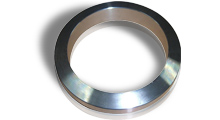
Used for the flange seal of a high-pressure pipe. The page states the solid lens ring is made from forgings, rolled materials and pipes.


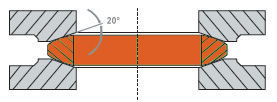
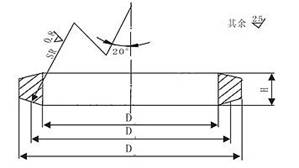
Spherical lens face meets the conical flange face on both sides — line contact, not surface contact.
Kaxite manufactures lens ring joint gaskets to API 6A, ASME B16.20, DIN 2693-67, JPI-7S-23-72 and DIN 2696-1999. The lens ring seals by line contact: the spherical lens face presses against the conical flange face, the initial contact loop deforms plastically, and the loop becomes a sealing belt under preload.
Because the contact area is a line and not a wide flat face, the lens ring is pressure-energized, has large expansion and contraction compensation, and compacts easily. The trade-off is that the spherical face easily leaves a pressing mark on the flange cone, so individual rings have poor interchangeability.
Send InquiryThe lens ring has a spherical (ball-face) outer profile. It sits inside the conical sealing surface of the pipe flange on both sides, forming an initial contact loop, not a flat contact area.
Under preload the initial contact loop deforms plastically, so the loop becomes a narrow sealing belt. That belt is the actual sealing element, which is why the lens ring is described as a line seal.
Once the joint is pressurized, the internal pressure drives the lens face against the cone. The page describes the lens ring as pressure-energized, like the double-cone gasket.
The contact face is formed naturally by the spherical surface and the flange bevel, so alignment is easier than with a flat ring. The same property means the ring easily leaves a pressing mark, so interchangeability is poor.
Used for the flange seal of a high-pressure pipe. The page states the solid lens ring is made from forgings, rolled materials and pipes.
Used for the blind flange seal of a high-pressure pipe. The page states blind lens rings are made from forgings.
The original page lists "metal lens gaskets" as a family that includes flat, triangular, double-cone, C-ring, serrated, wave and hollow O-ring types. Those are related types, not the lens ring itself. This page covers the lens ring.
Soft iron · Low carbon steel · F5 · F11 · SS410
SS304 · SS316 · SS347
Copper · Aluminium · Titanium · Zirconium 702
Inconel 600 · Inconel 625 · Incoloy 800 · Incoloy 825 · Monel 400 · Nickel 200 · Hastelloy C276
Whichever grade you choose, the 15-20 HB hardness rule against the flange face still applies. Do not select a ring harder than the flange, even for the high-temperature alloys.
Wellhead and high-pressure flange service.
Metallic gaskets for ring joint flanges.
German lens ring flange standard.
Japanese petroleum industry lens ring standard.
German high-pressure lens ring standard.
Standard and non-standard sizes to drawing.
Confirm the flange standard (API 6A, ASME B16.20, DIN, JPI or custom) and the required ring number or drawing. Confirm the flange Brinell hardness.
Pick a grade whose hardness sits 15-20 HB below the flange face. The 15-20 HB rule is a design input, not an afterthought.
The solid lens ring is produced from forgings, rolled materials and pipes; the blind lens ring from forgings. The spherical face and cone seat are machined to the ring drawing.
Ring number, material grade, hardness and spherical face are checked before packing. Sealing faces are protected against impact. Inspection and documents are confirmed through the quality process.
The lens ring sits in the ring joint gasket range alongside the RX ring joint gasket, the BX ring joint gasket, the R-octagonal ring joint gasket and the R-oval ring joint gasket. Each of these seals differently — lens rings seal on a conical face, R, RX and BX rings seal in a groove — so they are not interchangeable with each other.
Kaxite is a Ningbo-based manufacturer of metallic and semi-metallic gaskets, including lens ring joint gaskets, BX ring joint gaskets, RX ring joint gaskets, R-oval and R-octagonal ring joint gaskets, and spiral wound gaskets. The company address and contact details are listed on this page.
The lens ring seals by line contact. The spherical lens face presses against the conical flange face; the initial contact loop deforms plastically into a sealing belt under preload. The contact face is formed naturally by the spherical surface and the flange bevel, so alignment is easier than a flat ring, and the gasket is pressure-energized, like the double-cone gasket.
The page lists a working pressure window of 10-32 MPa and a temperature range of -196 to 1000°C. Gasket factor m=5.50-6.50 and minimum pre-tightening pressure y=126.6-182.8 MPa are also listed. Confirm the exact rating for your ring size and material before ordering.
The page states that the interchangeability of individual lens rings is poor. Because the spherical face contacts the flange cone, it easily leaves a pressing mark, so each ring should be treated as matched to its own flange. It is not a drop-in swap for R-oval, R-octagonal, RX or BX rings.
The ring hardness must be 15-20 HB lower than the mating flange face hardness. Confirm the flange Brinell hardness before selecting the ring material.
Standards: API 6A, ASME B16.20, DIN 2693-67, JPI-7S-23-72, DIN 2696-1999; custom and non-standard sizes available. Materials: soft iron, low carbon steel, SS410, SS304, SS316, SS347, F5, F11, copper, aluminium, Inconel 600, Inconel 625, Incoloy 800, Incoloy 825, Monel 400, titanium, Nickel 200, Hastelloy C276, Zirconium 702.
A solid (perforated) lens ring is used for the flange seal of a high-pressure pipe; a blind lens ring is used for the blind flange seal of a high-pressure pipe. The page states that the solid lens ring uses forgings, rolled materials and pipes, while the blind lens ring uses forgings.
The page lists oil, gas, petrochemical and offshore industries, plus valves, pipe-work assemblies and vessel joints, sealing high-pressure and high-temperature flanged connections.
The page body does not state MOQ, sample lead time or bulk lead time. Confirm these with the supplier before placing a bulk order.
Send the flange standard, ring number or drawing, ring material, flange hardness, working pressure, temperature, media and quantity. MOQ, sample lead time and bulk lead time are confirmed after review.
Send the flange standard, ring number or drawing, material, flange hardness, working pressure, temperature and quantity. Confirm the pressure window, hardness rule and ring material on inquiry.
Send Inquiry Contact SalesAddress
No 432 Zhenhai Middle Road, Luotuo Street, Zhenhai District, Ningbo City, Zhejiang China


